VIEW ALL NGOPINI
SHARE


Background
The government claims that the mandatory biodiesel programme provides many benefits, such as reducing greenhouse gas emissions, stabilising palm oil prices, increasing added value, reducing fuel consumption and imports, improving the trade deficit, and so on. However, several findings indicate that this programme has also increased deforestation and reduced biodiversity due to land conversion. Findings from the IUCN (2018) reveal that at least 50 per cent of total deforestation between 2005 and 2015 on the island of Borneo was caused by palm oil planting and expansion.
Recently, the government has allocated funds from the state budget to support the Palm Oil Plantation Fund Management Agency (BPDP-KS) in financing the mandatory biodiesel programme through subsidies. Within the framework of the National Economic Recovery (PEN), the government has provided Rp2.78 trillion to cover the BPDP-KS's current poor financial position.
Reflecting on energy subsidies in recent years, government action is risky because biodiesel prices are highly vulnerable to global conditions. With the pandemic situation yet to subside and the government's ambition to increase the biodiesel blend, the government needs other, more appropriate measures. On the other hand, the sustainability of the programme is needed to improve energy security and keep domestic demand stable.
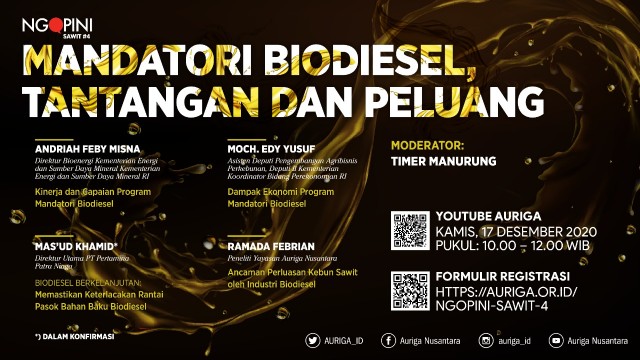
How prepared is the government to implement the mandatory biodiesel programme, given the current situation, such as the Covid-19 pandemic and the trade war over palm oil? To address this, Auriga will hold a webinar on Ngopini Sawit #4: Mandatory Biodiesel, Challenges and Opportunities.
Speakers
Time and Place
Day and Date: Thursday, 17 December 2020
Time: 10:00 a.m. – 12:00 p.m. WIB
Location: Auriga Nusantara YouTube channel