VIEW ALL NGOPINI
SHARE


Background
The new leaders of the United States (US), President Joe Biden and Vice President Kamala Harris, appear to be taking a very different approach to their predecessors, Trump and Pence. During the campaign, it was clear that Biden and Harris considered climate change to be a priority issue, as evidenced, for example, by their tendency to shift from fossil fuels to renewable energy. The order to re-enter the US into the Paris Agreement was one of the executive orders signed by Biden as soon as he took office in the White House, in contrast to the Trump-Pence policy of withdrawing the US from the global agreement. The approach to China, both globally and in Asia, also appears to be different under Biden-Harris. In short, there is a possibility of change in the global order and/or diplomacy.
With its large tropical forests, Indonesia is one of the countries affected by the discourse or diplomacy on climate change. The Jokowi administration's dependence on coal energy is also likely to be affected by the Biden-Harris approach. Not only that, Indonesia's palm oil industry could also be affected by increasing international market pressure to halt deforestation, including that caused by the expansion of palm oil plantations.
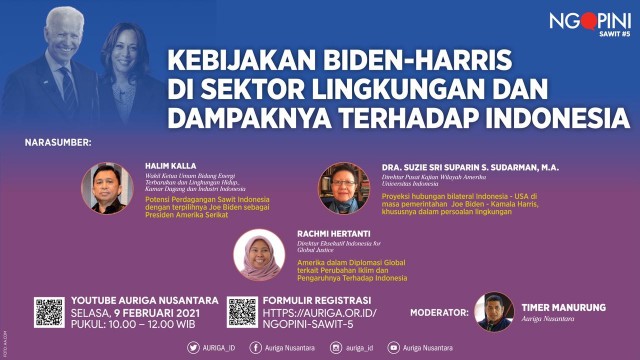
To learn more about the impact of changes in the US political constellation on Indonesia, particularly in the natural resources and environment sectors, Auriga Nusantara has made this the theme of its online discussion Ngopini Sawit #5: The Biden-Harris policy in the environmental sector and its impact on Indonesia.
Speakers
Time and Place
Day and Date: Tuesday, 9 February 2021
Time: 10:00 a.m. – 12:00 p.m. WIB
Location: Auriga Nusantara Youtube Channel