VIEW ALL NGOPINI
SHARE


Background
The Indonesian Law Number 33/2004 on Fiscal Balance between the Central Government and Regional Governments grants greater authority to regional governments, particularly in the management of natural resources within their territories. However, the principle of decentralised management in the natural resources sector has not been fully implemented. For example, state revenues from several plantation commodities produced by regional governments mostly go to the central government treasury.
With the area of oil palm plantations in Indonesia reaching 16.3 million hectares (Ministry of Agriculture, 2019), palm oil production is recorded at 52 million tonnes (Central Statistics Agency, 2020). The government collects state revenue in the form of taxes and non-tax state revenue (PNBP) from the oil palm plantation sector, but only a small portion is allocated to the regions.
These revenues should be returned by the central government to local governments in the form of Revenue Sharing Funds (DBH), as is customary in fiscal decentralisation systems in the forestry, mining and fisheries sectors. This means that, in principle, decentralisation has not yet been implemented, because the principle of money follows function is not working. In principle, the amount of authority delegated should be accompanied by a budget commensurate with the amount of authority (Brodjonegoro & Simajuntak, 2005; Fadliya & McLeod, 2010).
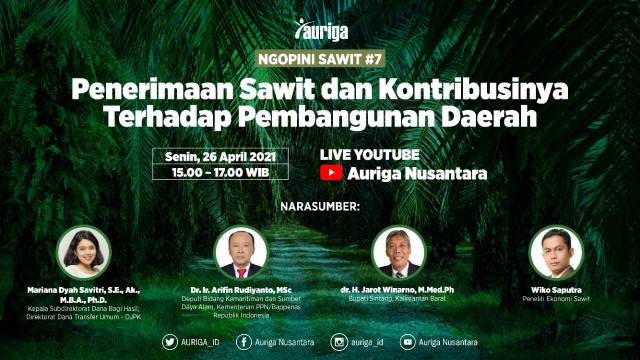
So how does the state revenue system in the palm oil sector actually work, and does it contribute appropriately to the development of palm oil plantation management areas? To answer these questions, Auriga Nusantara held an online discussion, Ngopini Sawit #7: "Palm Oil Revenue and Its Contribution to Regional Development".
Speakers
Date and Time:
Date: Monday, 26 April 2021
Time: 15.00 - 17.00 WIB
Location: Auriga Nusantara Youtube Channel