VIEW ALL NGOPINI
SHARE


Background
The COVID-19 pandemic has triggered a crisis. Not only a public health crisis, but also an economic and political crisis. According to Johns Hopkins University & Medicine, as of 12:32 p.m. WIB on 6 June 2020, the virus has infected 6,170,556 people and caused 372,099 deaths. A political crisis is now unfolding in Brazil and the United States. Unemployment in the United States, for example, has risen sharply to 14.7%, the worst since the Great Depression.
However, the post-COVID crisis seems inevitable. Various policy and financial instruments have been prepared, such as the Fed's decision to set aside more than US$3 trillion (around Rp 43,933 trillion) in loans and its ultra-low interest rate policy. European Union leaders are proposing a coronavirus rescue plan worth US$825 billion (around Rp 12,081 trillion), while China is providing an economic recovery package worth 4 trillion yuan (around Rp 8,100 trillion). In Indonesia, the policy taken is to increase the 2020 state budget by Rp 405 trillion to deal with the impact of Covid.
Indonesia is being directed towards a new normal, meaning that the economy will be driven. During and after the crisis, as in the 1998 crisis, the extractive industry tends to be boosted. The ease of obtaining immediate results in a short time means that the production of raw products often becomes a shortcut. Subsidies through policies and regulatory relaxation tend to be provided. This is very likely to include the expansion of oil palm plantations.
But should this be the case? Should we expand deforestation or do we have other options? Can we learn from the past and improve by focusing on domestic needs and more sustainable palm oil industrialisation?
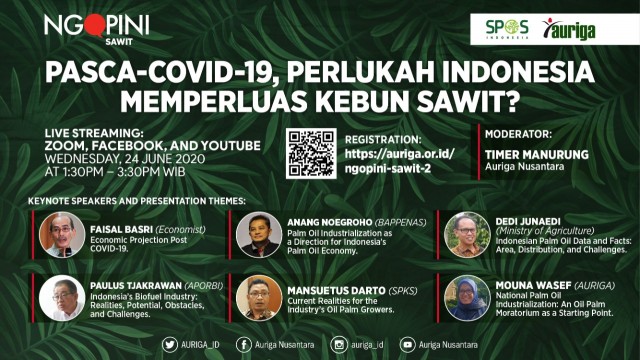
Ngopini Sawit #2: Post-COVID-19, Does Indonesia Need to Expand Palm Oil Plantations? was initiated to discuss this issue.
Speakers:
Time and location:
Day/date : Wednesday, 24 June 2020
Time : 13:30 – 15:30 WIB
Location : Youtube Auriga Nusantara