VIEW ALL NGOPINI
SHARE


Background
The availability of reliable data is one of the key requirements for the sustainability of an industry. It is the main foundation for achieving sustainable industrial management. The palm oil industry is Indonesia's flagship industry in the plantation sector. Touted as one of the pillars of the country's economy, this industry still has many issues that need to be resolved.
The biggest challenge for Indonesia in the palm oil sector is governance, whether in terms of land use regulations, the environment, social impact, or deforestation. These facts affect the image of palm oil in the international community. Furthermore, in September 2022, the European market passed the European Due Diligence Regulation. This regulation will ensure that commodities and products circulating in the European Union are legal and sustainable. Palm oil is one of six commodities affected by this regulation.
This situation shows that market acceptance is becoming increasingly selective and paying close attention to the origin of the raw materials used in the products consumed. To determine the traceability of a product back to its source, there needs to be traceability and transparency in the industry's supply chain. This is important in efforts to support the strengthening of a productive, efficient and competitive industry.
The supply chain in the palm oil industry is highly complex, encompassing large-scale producers down to the grassroots level, namely independent smallholders. Of course, the supply chain schemes for independent palm oil industries and corporate palm oil industries have different supply chain patterns. This diversity should be a concern for all parties, especially policymakers and business actors. This is so that every supply chain pattern maintains and pays attention to sustainability aspects.
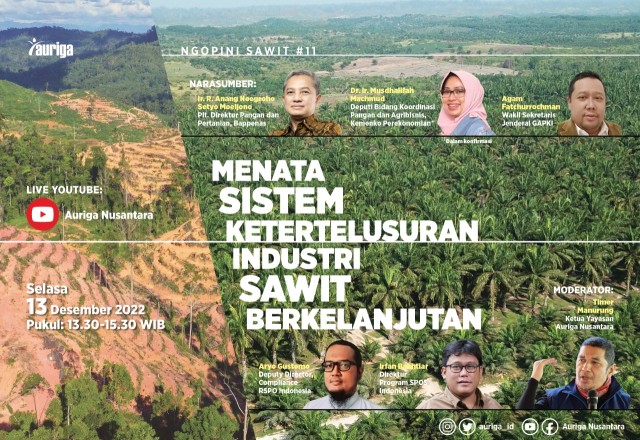
The development of Indonesia's palm oil industry shows that there is a need for improvements in governance, particularly in the traceability of the supply chain from upstream to downstream. Traceability is a key benchmark for efforts to transform the industry's supply chain. This is why improving the traceability data for agribusiness commodities, particularly palm oil, has become a priority. Therefore, Auriga Nusantara has made this the theme of its virtual discussion Ngopini Sawit #11: "Organising a Traceability System for a Sustainable Palm Oil Industry".
Speakers:
Time and Location
Day and Date: Tuesday, 13 December 2022
Time: 13.30 - 15.30 WIB
Location: Youtube Auriga Nusantara