VIEW ALL NGOPINI
SHARE


Background
The Indonesian palm oil industry cannot be separated from plasma palm oil. Although it does not contribute significantly to state revenue, plasma palm oil directly benefits the people as farmers. Unfortunately, the government does not pay as much attention to it as it does to plantation companies, even though it has been mandated by Law No. 39 of 2014 on Plantations.
Law No. 39 of 2014 mandates that plantation companies must facilitate the development of community plantations (plasma) covering at least 20% of the total area of the plantation. Unfortunately, the strategic position of the palm oil industry has not been able to encourage the fair involvement of palm oil farmers, as reflected, for example, in the suboptimal fulfilment of plasma palm oil plantation development.
At the end of 2018, the total area of plasma land was only around 617,000 hectares. In fact, the area of large-scale oil palm plantations in 2018 was 8,507,462 hectares (Directorate General of Plantations, Ministry of Agriculture, 2020), which means that, roughly calculated, the plasma area should have reached 1,701,492 hectares. To encourage inclusive growth in the palm oil industry, plasma palm oil plantation development policies are important so that palm oil plantation development does not cause economic inequality, as the benefits of the palm oil industry can be enjoyed fairly by the communities surrounding the palm oil plantations.
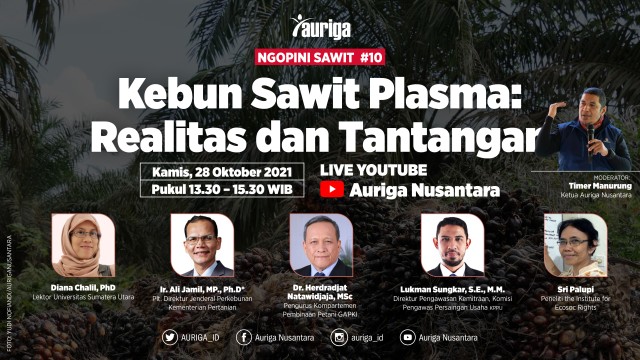
What is the reality of implementing this policy and what are the challenges? To answer these questions, Auriga Nusantara held an online discussion, Ngopini Sawit #10: "Plasma Palm Oil Plantations: Reality and Challenges".
Speakers:
Time and Location
Day and Date: Thursday, 28 Oktober 2021
Time: 13.30 - 15.30 WIB
Location: Youtube Auriga Nusantara